Divorce Process
Do You Need a Lawyer to Get a Divorce in Ontario?
Do You Need a Lawyer to Get a Divorce in Ontario?
Do You Need a Lawyer to Get a Divorce in Ontario?
•
6 MIN READ
6 MIN READ

Divorce Process
•
Yes, in certain circumstances.
Some Ontario paralegals are authorized by the Law Society of Ontario as Family Legal Services Providers (FLSPs). This authorization permits them to provide certain family legal services, including assisting with eligible joint and uncontested divorce applications.
For a divorce matter to fall within an FLSP’s permitted scope, the application must be for a divorce only, neither spouse can oppose the divorce, and both spouses must ordinarily reside in Canada.
If there are unresolved issues involving parenting, child support, spousal support, property division or other matters arising from the separation, the divorce may fall outside the permitted scope of an FLSP and assistance from a family lawyer may be required.
Discount Divorce Ontario is operated by Cordaie Paralegal Services. Damian Cordaie is a licensed Ontario paralegal and an authorized Family Legal Services Provider with the Law Society of Ontario.
Our service is designed for eligible joint and uncontested divorce matters that fall within the permitted FLSP scope.
If you are unsure whether your divorce qualifies, our eligibility questionnaire can help us determine whether your matter appears suitable for our service.
If you are considering divorce in Ontario, one of the first questions you may have is whether you need to hire a lawyer.
The short answer is no — you are not generally required to have a lawyer to apply for a divorce in Ontario.
A person can prepare and file their own divorce documents, and depending on the circumstances, other licensed legal professionals may also be able to provide services within their permitted scope of practice.
However, whether you should obtain legal advice is a different question. Divorce legally ends a marriage, but separation can involve other important issues such as parenting arrangements, child support, spousal support and property division.
Understanding the difference can help you decide what kind of assistance may be appropriate for your situation.
Generally, no.
Ontario's family court system does not require every person applying for a divorce to be represented by a lawyer. You can represent yourself and prepare and file the required court documents on your own.
This is sometimes referred to as being self-represented.
For a straightforward divorce where the spouses are not asking the court to decide other disputed family-law issues, the process may primarily involve preparing the required documents, filing them with the court and completing the necessary procedural steps.
That does not mean every divorce is simple, however.
A divorce may be more straightforward when the spouses are seeking only a divorce and there are no other issues that need to be decided by the court as part of the proceeding.
For example, the spouses may already have addressed matters such as:
Parenting arrangements;
Child support;
Spousal support; and
Property issues.
Depending on the circumstances, the divorce may proceed as either a joint divorce or an uncontested divorce.
In a joint divorce, both spouses apply for the divorce together.
There is no applicant and respondent opposing one another. Both spouses participate in the application and sign the required documents.
In an uncontested divorce, one spouse starts the divorce proceeding as the applicant.
The other spouse is generally served with the application and has an opportunity to respond. If no Answer is filed within the applicable time and the other requirements are satisfied, the divorce may proceed on an uncontested basis.
This distinction is important.
A Divorce Order legally ends the marriage, but obtaining a divorce does not necessarily resolve every issue arising from a separation.
Depending on the circumstances, spouses may also need to address matters involving:
Parenting time and decision-making responsibility;
Child support;
Spousal support;
Division of property;
The matrimonial home; and
Other financial or family-law issues.
Those issues can be legally significant even where both spouses agree that they want a divorce.
Even though a lawyer is not automatically required to obtain a divorce, there are circumstances where independent legal advice may be particularly important.
For example, you may want to speak with a family lawyer if there is a disagreement about parenting, support or property; if your spouse has started making claims against you; if you are unsure about your legal rights or obligations; or if your circumstances are unusually complicated.
Legal advice may also be important before signing an agreement that affects your financial or family-law rights.
The appropriate type of assistance depends on your particular circumstances.
Yes.
People are permitted to represent themselves in Ontario family court proceedings.
That means you can determine which forms are required, prepare the documents, file them with the appropriate court and complete the remaining procedural requirements yourself.
The important question is not simply whether you can do it yourself, but whether you are comfortable identifying and completing the required steps correctly.
Court forms must contain accurate information, filing requirements must be followed, and additional documentation may be required as the divorce progresses.
If something is incomplete or incorrect, the court may require it to be corrected before the divorce can proceed.
Your spouse does not necessarily have to agree to the divorce simply because you are the person applying.
A joint divorce requires both spouses to participate in the application.
An individual divorce application is different. One spouse can commence the proceeding and the other spouse is generally served with the application and given an opportunity to respond.
If the other spouse does not file an Answer within the applicable period and the legal requirements for the divorce are otherwise satisfied, the proceeding may generally continue on an uncontested basis.
If the other spouse does respond and raises disputed family-law claims, however, the matter can become considerably more complicated.
Not necessarily.
Straightforward joint and uncontested divorces can often be decided based on the documents filed with the court without the spouses attending a contested courtroom hearing simply to obtain the divorce.
However, the divorce is still a court proceeding.
A judge must ultimately be satisfied that the legal requirements for granting the divorce have been met, and the court may request additional information or corrections where necessary.
It can be.
Someone who needs advice or representation concerning disputed parenting, support, property or other family-law claims may have very different needs from someone whose outstanding task is obtaining the divorce itself.
That is why it is important to determine what issues remain unresolved before choosing the type of legal service you need.
A lower-cost divorce service may be appropriate for some straightforward matters, while other situations may require more extensive legal advice or representation.
Start by looking at what remains unresolved between you and your spouse.
If you are seeking only a divorce and the other family-law issues have already been dealt with or do not require a court decision, your matter may be suitable for a straightforward joint or uncontested divorce process.
If there are unresolved disputes involving parenting, support, property or other claims, you may need legal advice about those matters before deciding how to proceed with the divorce.
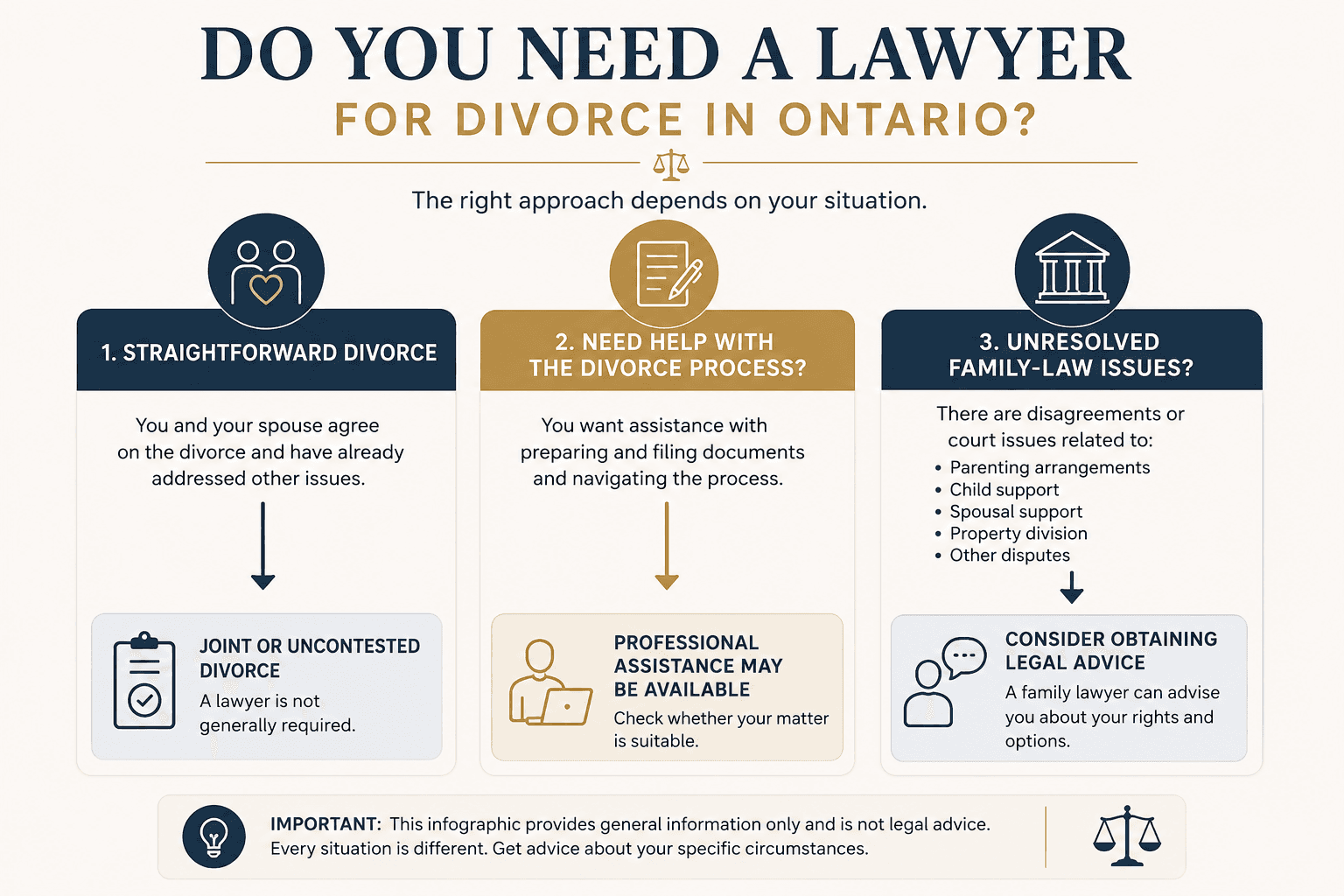
You do not generally need to hire a lawyer simply to apply for a divorce in Ontario.
But not needing a lawyer to file for divorce does not mean that everyone going through a separation should proceed without legal advice.
The right approach depends on what remains unresolved, whether there are other family-law claims involved, and the complexity of your circumstances.
For people whose matters are suitable for a straightforward joint or uncontested divorce, professional assistance with the divorce process can provide an alternative to preparing and navigating the paperwork entirely on their own.

Do I Need a Lawyer to Get Divorced in Ontario?
Can I File for Divorce Myself in Ontario?
When Should I Consider Speaking With a Family Lawyer?
Do I Need a Lawyer If My Spouse and I Agree on the Divorce?
Do I Have to Go to Court in Person to Get Divorced?

Cordaie Paralegal Services provides a flat-fee divorce service for eligible joint and uncontested divorces in Ontario.
For $995 + HST + disbursements, we handle the divorce process included in your retainer, including preparation and filing of the required divorce documents and communication concerning the court process.
Complete our short eligibility questionnaire to see whether your divorce may be a good fit for our service.
There’s no obligation to retain us simply because you complete the eligibility check.

