Divorce Timeline
How Long Does a Divorce Take in Ontario? (2026 Timeline)
How Long Does a Divorce Take in Ontario? (2026 Timeline)
How Long Does a Divorce Take in Ontario? (2026 Timeline)
•
8 MIN READ
8 MIN READ

Divorce Timeline
•
Getting divorced in Ontario is not an instant process. Even when spouses agree on everything and the divorce is straightforward, there are several procedural stages that must be completed before the marriage is legally ended.
The timeline can depend on whether you file a joint or individual divorce application, whether documents need to be served, whether the other spouse responds, whether the court requires corrections or additional information, and how long the court takes to process the application.
There is also an important distinction between the date a judge grants the divorce and the date the divorce actually takes effect.
This guide walks through the Ontario divorce timeline from preparing and filing the application to the day your divorce becomes effective.
There is no guaranteed timeline for obtaining a divorce in Ontario.
For a straightforward joint or uncontested divorce, the process involves several stages, including preparing the documents, filing the application, completing any required service and waiting periods, submitting the remaining divorce documents and waiting for the court to review the request.
How long the entire process takes can depend on:
Whether the application is joint or individual;
How quickly the required information and documents are provided;
Whether service is required;
Whether the other spouse responds;
Whether documents need to be corrected;
Whether there are issues involving children or support;
Whether the court requests additional information; and
Court processing times.
Be cautious about anyone promising that your divorce will be completed by a specific date. Once documents have been filed, significant parts of the timeline are outside the legal representative's control.
Not every divorce follows exactly the same timeline.
A straightforward application where all of the necessary information is available and the documents are completed correctly may progress relatively smoothly.
Delays can occur when information is missing, documents need to be corrected, a spouse is difficult to serve or the court requires additional information.
The type of application also matters.
With a joint divorce, both spouses apply together. With an individual divorce application, one spouse starts the proceeding and the issued application generally needs to be served on the other spouse.
That creates an additional procedural stage before an individual uncontested divorce can move forward.
A joint divorce can eliminate some of the procedural steps required with an individual application.
Because both spouses apply together in a joint divorce, the application does not need to be served by one spouse on the other.
Because both spouses apply together, a joint divorce does not involve the same service and response stage as an individual divorce application.
However, that does not mean a joint divorce is immediate.
The spouses still need to provide the required information, complete the necessary documents, file the application and complete the remaining steps required for the court to consider the divorce.
The court must then review the materials and determine whether the requirements for granting the divorce have been satisfied.
For that reason, even a straightforward joint divorce does not have a guaranteed completion date.
An individual uncontested divorce generally includes an additional stage that isn't required in the same way with a joint application: service on the other spouse.
After the divorce application has been issued by the court, the respondent generally must be served with the application and supporting documents.
The applicant cannot personally serve the application on the respondent.
Once proper service has taken place, the respondent has a specified period in which to serve and file an Answer.
If the respondent does not respond within the applicable period, the applicant may generally proceed with the additional steps required to seek the divorce on an uncontested basis.
This means the time required for service and the response period need to be factored into the overall timeline.

For an individual divorce application, the amount of time the respondent has to serve and file an Answer depends on where they were served.
Generally, a respondent who is served in Canada or the United States has 30 days to serve and file an Answer.
If the respondent is served outside Canada and the United States, the period is generally 60 days.
The response period begins after the respondent has been properly served.
If the applicable deadline passes without an Answer being served and filed, the applicant may be able to continue with the divorce as an uncontested proceeding.
However, the expiry of the response period does not mean the divorce is automatically granted. Additional documents and procedural steps are still required.
If the respondent does not serve and file an Answer within the required period, the applicant can move toward having the divorce considered on an uncontested basis.
Additional documents must be prepared and submitted to the court.
The materials provided to the court must contain the information required for a judge to determine whether the legal requirements for divorce have been satisfied.
If children are involved, information concerning child support may also be required because the court has an obligation under the federal Divorce Act to satisfy itself that reasonable arrangements have been made for the support of the children of the marriage before granting the divorce.
The fact that the other spouse did not respond therefore does not eliminate the court's review of the application.
This is one of the hardest parts of the divorce timeline to predict.
There is no single guaranteed Ontario-wide processing time for a judge to review and grant a divorce.
Processing times can vary depending on the courthouse, the volume of matters being handled and whether the court identifies anything in the documents that requires clarification or correction.
Once the necessary documents have been submitted, the parties may simply need to wait while the application moves through the court system.
This is why estimates about the total length of a divorce should be treated as estimates rather than guaranteed completion dates.
A number of issues can cause a straightforward divorce to take longer than expected.
Common sources of delay can include:
Missing or incomplete information;
Incorrectly completed documents;
Difficulty serving the respondent;
The respondent filing an Answer;
Inconsistencies between documents;
Issues involving child support;
The court requesting additional information;
Documents being rejected and requiring correction;
Unresolved family-law claims; and
Court processing times.
A particularly important distinction is whether the divorce remains uncontested.
If the other spouse responds and disputes claims or raises additional family-law issues, the matter may no longer follow the relatively straightforward uncontested divorce process.
If the judge is satisfied that the legal requirements have been met, the court can grant the divorce and issue a divorce order.
However, receiving a divorce order does not normally mean that you are legally divorced that same day.
Under Canada's Divorce Act, a divorce generally takes effect on the 31st day after the day the judgment granting the divorce is rendered.
That waiting period is an important part of the divorce timeline.
Until the divorce has taken effect, the marriage has not yet legally ended.
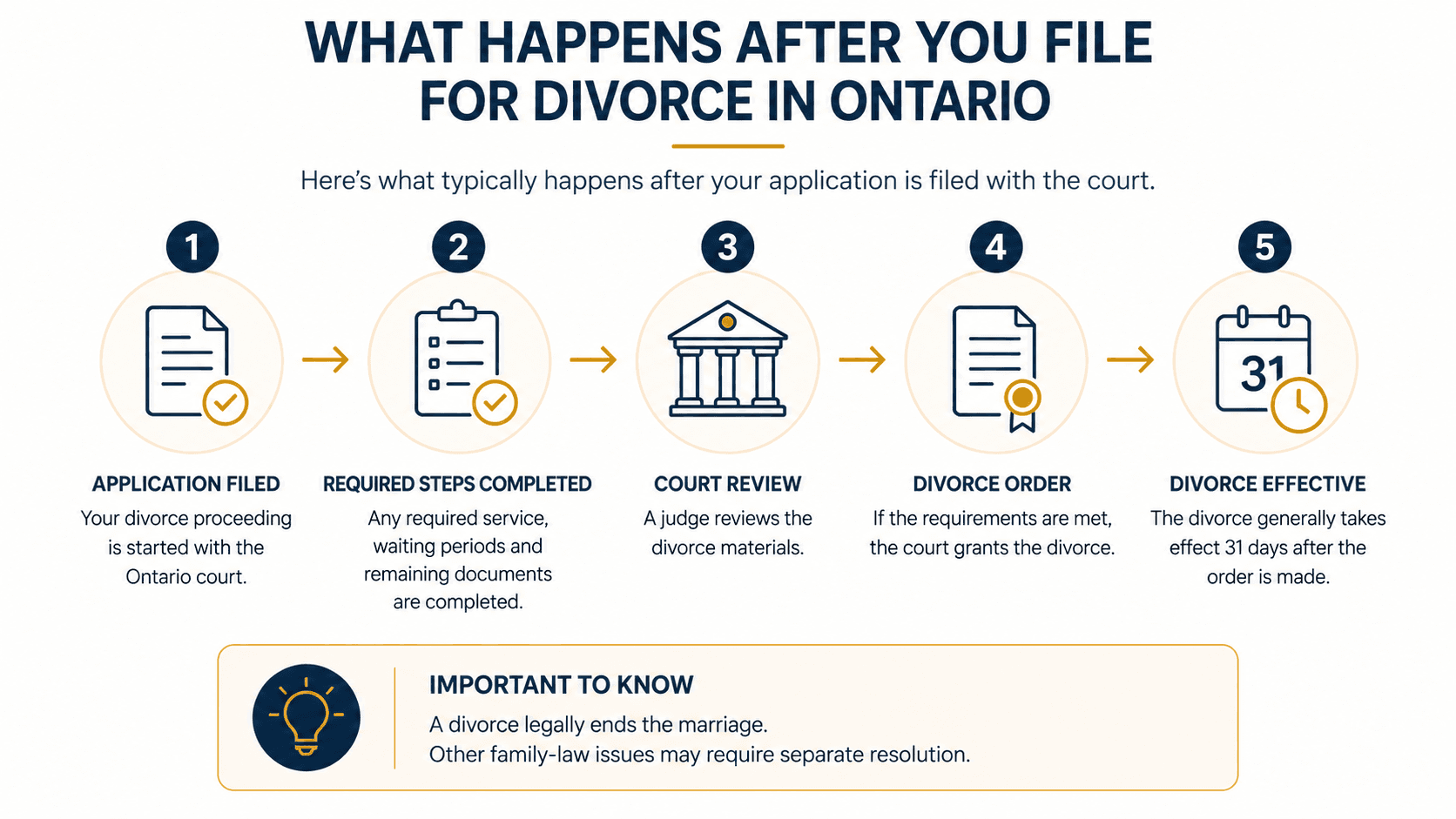
The 31-day period exists because the Divorce Act provides that a divorce generally takes effect on the 31st day after the judgment granting the divorce.
There are limited circumstances in which a court can order that a divorce take effect earlier.
For most straightforward divorces, however, the parties should expect the normal 31-day period to apply.
This is especially important if someone intends to remarry.
You should not assume that receiving the divorce order means you are immediately free to marry someone else. The divorce must first become effective.
After the divorce has taken effect, you can request a Certificate of Divorce from the court.
The certificate provides proof that the marriage has legally ended.
It is different from the divorce order.
You may need a Certificate of Divorce in the future for purposes such as remarriage or to provide formal proof of your marital status.
You do not necessarily need to obtain the certificate immediately, but it can be requested from the court after the divorce has become effective.
You cannot control how quickly a court processes or reviews a divorce application.
However, you can reduce the likelihood of avoidable delays.
Providing complete and accurate information promptly, ensuring the correct documents are prepared, completing service properly where required and responding quickly if the court requests additional information can help prevent unnecessary setbacks.
If spouses are able to cooperate with a joint application, that process also eliminates the service and response stages associated with an individual application.
But even then, no service provider or legal professional can guarantee the date on which the court will grant the divorce.
The goal should be to move the parts of the process that can be controlled forward efficiently while recognizing that court processing remains outside the parties' control.

How Long Does an Uncontested Divorce Take in Ontario?
Is a Joint Divorce Faster Than an Uncontested Divorce?
How Long Does My Spouse Have to Respond to Divorce Papers?
Am I Divorced as Soon as the Judge Grants the Divorce?
Can I Speed Up My Divorce in Ontario?

Cordaie Paralegal Services provides a flat-fee divorce service for eligible joint and uncontested divorces in Ontario.
For $995 + HST + disbursements, we handle the divorce process included in your retainer, including preparation and filing of the required divorce documents and communication concerning the court process.
Complete our short eligibility questionnaire to see whether your divorce may be a good fit for our service.
There’s no obligation to retain us simply because you complete the eligibility check.

