Divorce Process
How to Get a Divorce in Ontario: A Step-by-Step Guide
How to Get a Divorce in Ontario: A Step-by-Step Guide
How to Get a Divorce in Ontario: A Step-by-Step Guide
•
9 MIN READ
9 MIN READ

Divorce Process
•
Getting divorced in Ontario involves more than simply completing a form. There are specific documents to prepare, court filing requirements to follow and steps that can differ depending on whether you are applying jointly with your spouse or starting the divorce application yourself.
For a straightforward divorce, much of the process can be completed through paperwork without the spouses appearing at a court hearing. However, the court must still be satisfied that the legal requirements for granting the divorce have been met. For straightforward divorces, the process can differ depending on whether the spouses apply jointly or one spouse starts the application and the matter proceeds uncontested.
This guide walks you through the Ontario divorce process step by step, from determining whether you are eligible to apply through to receiving your divorce order and, if needed, obtaining a Certificate of Divorce.
Before starting a divorce application, you need to determine whether Ontario is the appropriate place to apply.
Generally, either you or your spouse must habitually resident in Ontario for at least one year immediately before the divorce proceeding is started.
You must also be legally married. Divorce is the legal process used to end a marriage. Common-law partners do not need a divorce when their relationship ends.
Not necessarily.
When the divorce is based on separation, spouses can generally start the divorce proceeding before they have been separated for a full year. However, the divorce cannot be granted on the basis of one year's separation until that period has been completed.
This distinction is important because people sometimes believe they must wait an entire year before they can even begin the process.
A divorce legally ends your marriage.
But a divorce does not automatically resolve every issue resulting from a separation.
Depending on your circumstances, there may also be issues involving:
Parenting arrangements;
Child support;
Spousal support;
Property division;
The matrimonial home;
Pensions or other assets;
Debts; or
Other financial or family-law matters.
If these issues remain disputed, your situation may require legal advice or services beyond a straightforward divorce application.
For people who have already resolved the other issues—or who have no other issues requiring determination—the remaining step may simply be obtaining the divorce itself.
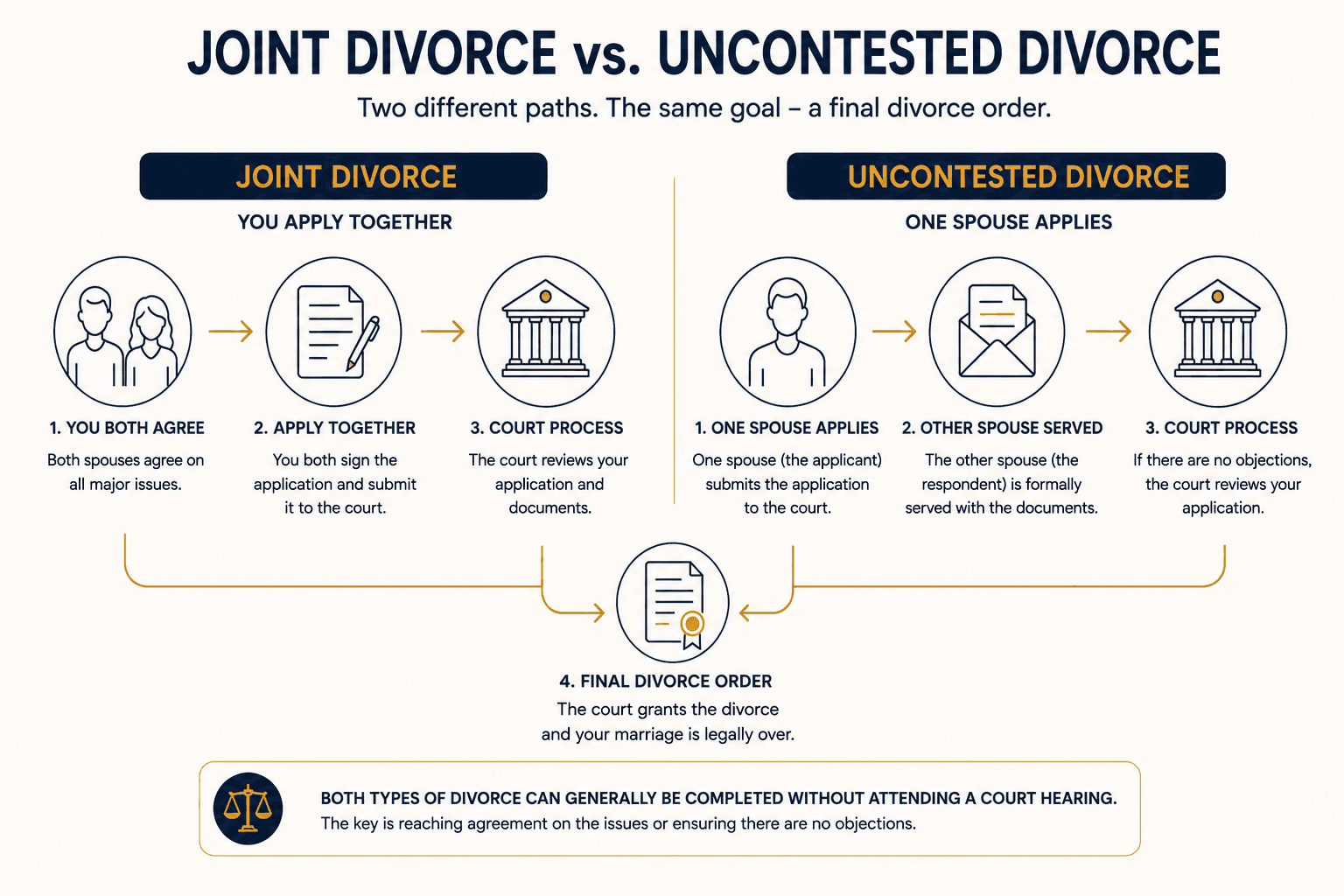
For a straightforward divorce, there are two common ways the application may proceed.
In a joint divorce, both spouses apply for the divorce together.
There is no applicant and respondent opposing one another. Both spouses participate in the application and sign the required documents.
A joint divorce can be a good option when both spouses:
Agree that they want the divorce;
Are willing to cooperate with the process; and
Are prepared to provide the information and signatures required.
You don't have to have a particularly friendly relationship to file jointly.
What matters is whether both spouses are willing and able to cooperate sufficiently to complete the divorce process together.
In an uncontested divorce, one spouse starts the divorce proceeding as the applicant.
The other spouse is then served with the divorce application and has an opportunity to respond.
If the other spouse does not oppose the divorce within the applicable time and the matter otherwise qualifies to proceed, the applicant can continue with the divorce as an uncontested matter.
This can be useful when the spouses aren't applying together but there is no actual dispute about ending the marriage.
Neither type of divorce is automatically "better."
The appropriate process depends on your circumstances.
Joint divorce may make sense when: both spouses are cooperating and want to participate in the application together.
Uncontested divorce may make sense when: one spouse wants to initiate the application independently and the other spouse is not expected to contest it.
If there are significant unresolved disputes between you, a simple joint or uncontested divorce may not be appropriate.
Before divorce documents can be prepared, you'll need information about yourself, your spouse and your marriage.
Depending on your circumstances, this can include:
Your legal name;
Your spouse's legal name;
Current addresses;
Dates of birth; and
Previous legal names, where applicable.
Date of marriage;
Place of marriage;
Date of separation; and
Information concerning any previous marriages where relevant.
If there are children of the marriage, additional information may be required concerning matters such as:
The children's names and dates of birth;
Where they live;
Parenting arrangements; and
Child-support arrangements.
You may also need to provide information about any:
Separation agreement;
Domestic contract;
Previous court order; or
Existing family-court proceeding.
Providing complete and accurate information at the beginning can help prevent unnecessary corrections and delays later in the process.

Your marriage certificate is an important document in the divorce process.
If you were married in Ontario and don't have your marriage certificate, you may need to order one from the Province of Ontario.
The document required for divorce purposes is generally the official marriage certificate, not simply the Record of Solemnization of Marriage that may have been provided following the wedding ceremony.
If you were married outside Ontario or outside Canada, different documentation or additional steps may sometimes be necessary.
Once the necessary information and documents have been collected, the appropriate court forms can be prepared.
The forms required will depend on factors such as whether the divorce is being filed jointly or by one spouse.
Accuracy matters.
Names, dates, addresses, information about children and other details should be carefully reviewed before filing.
Errors or missing information can result in the court requiring corrections or additional documentation, which can delay the process.
The divorce proceeding must be commenced in the appropriate Ontario Superior Court of Justice.
Court filing fees apply and are separate from professional legal fees.
Depending on the circumstances and current court procedures, documents may be submitted electronically through Ontario's authorized filing systems.
Once the proceeding is opened, the court assigns a court file number.
That number identifies the case throughout the remainder of the proceeding.
This is where joint and uncontested divorces follow somewhat different paths.
Because both spouses apply together in a joint divorce, the application does not need to be served by one spouse on the other.
Both spouses participate in the process.
When one spouse starts the proceeding, the other spouse generally needs to be formally served with the application.
There are specific rules governing service of family court documents.
After service, proof of service must be provided to the court, and the responding spouse is given an opportunity to respond.
If no Answer is filed within the applicable period and the other requirements are satisfied, the matter may proceed as an uncontested divorce.
Starting the divorce proceeding isn't the end of the process.
Additional documentation must generally be submitted before a judge can consider granting the divorce.
The required documents depend on the circumstances of the case.
The court reviews the materials to determine whether the legal requirements for divorce have been met.
Where children are involved, the court may also consider whether reasonable arrangements have been made for their support before granting the divorce.
This is one reason accurate information about child support is important even when both spouses agree that they want a divorce.
Once the required materials have been submitted, the divorce goes before the court for consideration.
A straightforward uncontested or joint divorce will usually not require the spouses to attend a courtroom hearing simply to obtain the divorce.
The materials are generally considered by a judge based on the filed documentation.
However, the court can request corrections, clarification or additional information before granting the divorce.
Court processing times vary, so no legal-service provider can responsibly guarantee the exact date on which a divorce will be granted.
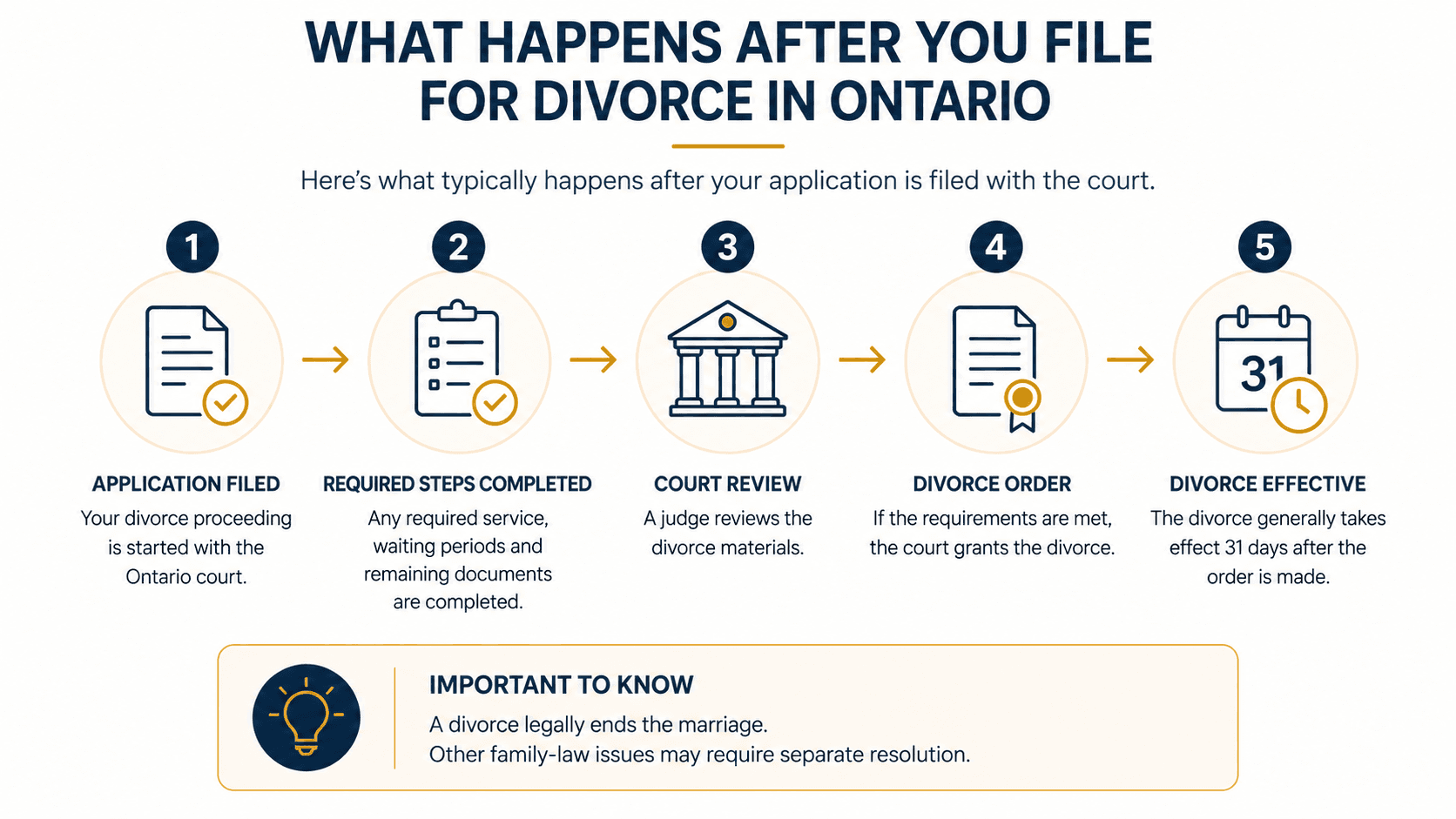
If the judge is satisfied that the legal requirements have been met, the court can grant a Divorce Order.
But there's one more important distinction:
A divorce generally takes effect on the 31st day after the Divorce Order is made, unless the court orders otherwise.
At that point, the marriage is legally ended.
A Divorce Order and a Certificate of Divorce are not the same document.
The Divorce Order is the court order granting the divorce.
A Certificate of Divorce confirms that the divorce has taken effect.
You may need a Certificate of Divorce in the future—for example, if you plan to remarry.
It can be requested from the court after the divorce has become effective.

How Long Does a Divorce Take in Ontario?
How Much Does a Divorce Cost in Ontario?
Can You Get Divorced Without Going to Court?
What If Your Spouse Won't Cooperate?
Do You Need a Lawyer to Get Divorced in Ontario?

Cordaie Paralegal Services provides a flat-fee divorce service for eligible joint and uncontested divorces in Ontario.
For $995 + HST + disbursements, we handle the divorce process included in your retainer, including preparing and filing the required divorce documents and communicating with you about the court process.
Complete our short eligibility questionnaire to see whether your divorce may be a good fit for our service.
There’s no obligation to retain us just because you complete the eligibility check.

