Divorce Process
Joint vs. Uncontested Divorce in Ontario: What’s the Difference?
Joint vs. Uncontested Divorce in Ontario: What’s the Difference?
Joint vs. Uncontested Divorce in Ontario: What’s the Difference?
•
8 MIN READ
8 MIN READ

Divorce Process
•
If you and your spouse have decided that your marriage is over, one of the first practical questions may be how to apply for your divorce.
Two terms you’ll frequently encounter are joint divorce and uncontested divorce.
They can sound like the same thing. They aren’t.
Both can provide a relatively straightforward path to divorce when there isn’t a dispute that needs to be decided by the court, but there are important differences in who applies, who signs the application, whether the application needs to be served, and how the other spouse participates in the process.
Here’s what you need to know.

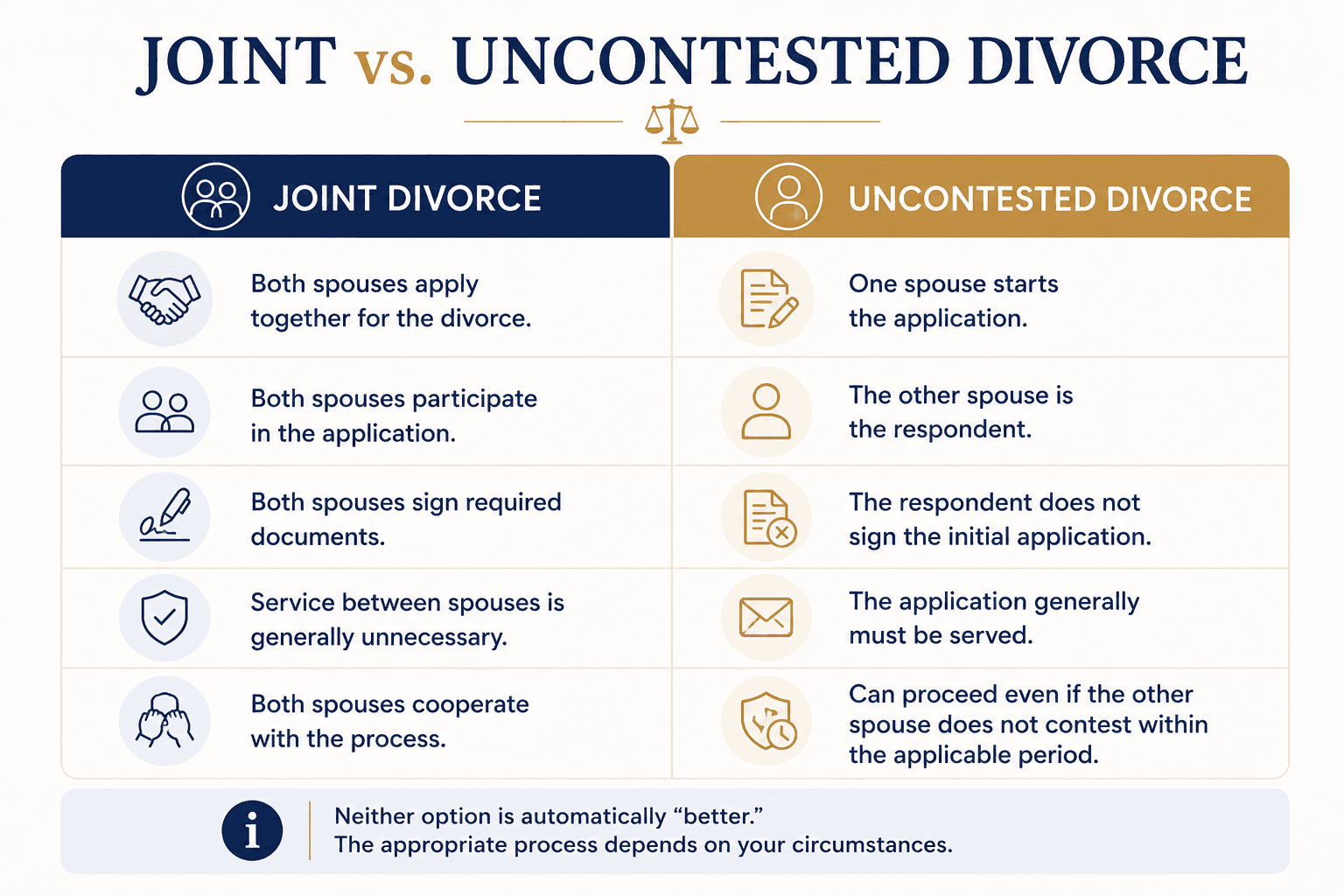
In a joint divorce, both spouses apply for the divorce together.
Rather than one spouse starting the divorce proceeding against the other, the spouses are joint applicants.
Both spouses participate in preparing and signing the divorce application, and both are asking the court to grant the divorce.
A joint divorce can be a good fit when:
• Both spouses want the divorce
• Both are willing to cooperate with the application
• Both are prepared to provide the information and signatures required
• There are no unresolved disputes that need to be litigated as part of the divorce proceeding
Because both spouses apply together in a joint divorce, the application does not need to be served by one spouse on the other.
An uncontested divorce typically begins with one spouse applying for the divorce.
That spouse is the applicant. The other spouse is the respondent.
Unlike a joint divorce, the respondent does not have to participate in preparing or signing the initial divorce application.
The application generally needs to be properly served on the respondent after it is issued by the court.
The respondent then has an opportunity to respond.
If the respondent does not contest the proceeding within the applicable time and the necessary procedural requirements are satisfied, the applicant can generally take the next steps toward having the divorce considered by the court.
The easiest way to understand the distinction is:
Joint divorce = you apply together.
Uncontested divorce = one spouse applies and the other spouse does not contest it.
That distinction affects several parts of the process.
• Both spouses are applicants
• Both participate in the application
• Both provide the required signatures
• The application generally does not need to be served between the spouses
• Both spouses are actively cooperating with the divorce process
• One spouse is the applicant
• The other spouse is the respondent
• The applicant can begin without the respondent signing the application
• The respondent must be formally served with the issued application
• The respondent has an opportunity to respond
Neither option is automatically “better.” The appropriate process depends on the circumstances.
This is one of the most common misconceptions about divorce.
Your spouse generally cannot prevent you from eventually obtaining a divorce simply because they don't want one.
For most straightforward divorces, the basis relied upon is that the spouses have lived separate and apart for at least one year.
A joint application requires cooperation because both spouses are applying together.
An uncontested application provides another route when only one spouse is prepared to initiate the process.
That means a spouse refusing to participate does not necessarily mean you cannot proceed.
However, if the other spouse contests claims or raises other family-law issues, the proceeding can become more complicated.
It depends on the type of application.
For a joint divorce, both spouses participate in and sign the documents requiring their signatures.
For an uncontested divorce, the applicant does not generally need the respondent to sign the initial divorce application.
Instead, the respondent is served with the issued application and given the opportunity to respond.
This is an important distinction for people who know their spouse probably won't cooperate with paperwork but don't expect them to actively contest the divorce.
For an individual divorce application, service is an important part of the process.
Once the application has been issued by the court, the respondent must generally receive it in accordance with the applicable service requirements.
The applicant cannot simply assume the other spouse knows about the divorce proceeding.
Proof of service will also generally need to be provided to the court.
With a joint application, the spouses are applying together, so the same service step between spouses is generally unnecessary.
For some couples, avoiding the service step is one reason a joint divorce may feel simpler.
But that only works when both spouses are prepared to cooperate throughout the application process.
Suppose you start an individual divorce application, properly serve your spouse, and your spouse does nothing.
That does not necessarily stop the divorce.
Once the applicable response period has passed, and assuming the respondent has not filed a response contesting the proceeding, you may be able to continue with the procedural steps required to have the divorce considered as an uncontested matter.
The court still has to review the materials and be satisfied that the legal and procedural requirements for granting the divorce have been met.
Silence from the respondent does not mean that the divorce is automatically granted.
Having children does not automatically prevent spouses from obtaining a joint or uncontested divorce.
However, children can affect what the court needs to consider.
In particular, where there are children of the marriage, the court must be satisfied that reasonable arrangements have been made for their support before granting a divorce.
If parenting arrangements, child support or other issues remain disputed, the situation may extend beyond the scope of a straightforward divorce-only service.
This is one reason it's important to distinguish between:
getting divorced, which legally ends the marriage;
and
resolving all of the legal issues arising from separation, which can involve support, parenting and property matters.
They are not necessarily the same thing.

A divorce does not automatically resolve every issue between former spouses.
Depending on the circumstances, separating spouses may also need to address matters such as:
• Spousal support
• Child support
• Parenting arrangements
• Division of property
• The matrimonial home
• Pensions or other assets
• Existing domestic contracts or court orders
If those matters are disputed or unresolved, obtaining advice about your rights and obligations may be important before proceeding with a divorce-only application.
Do not assume that obtaining the divorce itself resolves every financial or family-law issue arising from your separation.
For couples who are cooperating and willing to complete the process together, a joint divorce may be the more natural choice.
It eliminates the need for one spouse to commence the proceeding against the other and generally avoids the requirement to serve the application between them.
An uncontested divorce may make more sense when one spouse wants to handle the application independently.
For example, you may know that your former spouse isn't interested in helping prepare the paperwork but is unlikely to oppose the divorce.
The important question isn't simply which process sounds easier.
It's which process fits your circumstances.
Filing the initial application isn't the end of the process.
Depending on the type of application and the circumstances, additional steps and documents are required before the divorce can be submitted for judicial consideration.
The court may also identify missing information, require corrections or request additional materials.
Ultimately, a judge must be satisfied that the requirements for granting the divorce have been met.
If the divorce is granted, the divorce generally takes effect 31 days after the date of the divorce order, unless exceptional circumstances result in a different effective date.
After the divorce has taken effect, a Certificate of Divorce can be requested from the court if one is needed—for example, before remarriage.
The total cost depends on how you choose to handle the process.
Potential expenses can include:
• Court filing fees
• Professional fees
• Process-server fees for an individual application
• Marriage certificate or document-replacement costs
• Other disbursements
When comparing divorce services, look carefully at what the advertised price actually includes.
A low advertised fee may cover only document preparation, while other services may include filing and additional assistance throughout the court process.

Can I Get Divorced If My Spouse Won’t Sign?
Is a Joint Divorce Faster Than an Uncontested Divorce?
Is a Joint Divorce Cheaper Than an Uncontested Divorce?
Can We File for a Joint Divorce If We Don’t Get Along?
What Happens If My Spouse Contests the Divorce?

Cordaie Paralegal Services provides a flat-fee divorce service for eligible joint and uncontested divorces in Ontario.
For $995 + HST + disbursements, we handle the divorce process included in your retainer, including preparation and filing of the required divorce documents and communication concerning the court process.
Complete our short eligibility questionnaire to see whether your divorce may be a good fit for our service.
There’s no obligation to retain us just because you complete the eligibility check.

