Divorce Process
What Documents Do You Need to Apply for a Divorce in Ontario?
What Documents Do You Need to Apply for a Divorce in Ontario?
What Documents Do You Need to Apply for a Divorce in Ontario?
•
8 MIN READ
8 MIN READ

Divorce Process
•
Getting divorced in Ontario involves more than completing a single form.
The documents you need depend on the type of divorce application you are filing, whether you are applying jointly or individually, whether there are children of the marriage, and whether any other family-law issues are being addressed.
For a straightforward divorce, there are several documents and pieces of information that commonly form part of the process.
Knowing what you may need before you begin can make preparing your divorce application considerably easier.
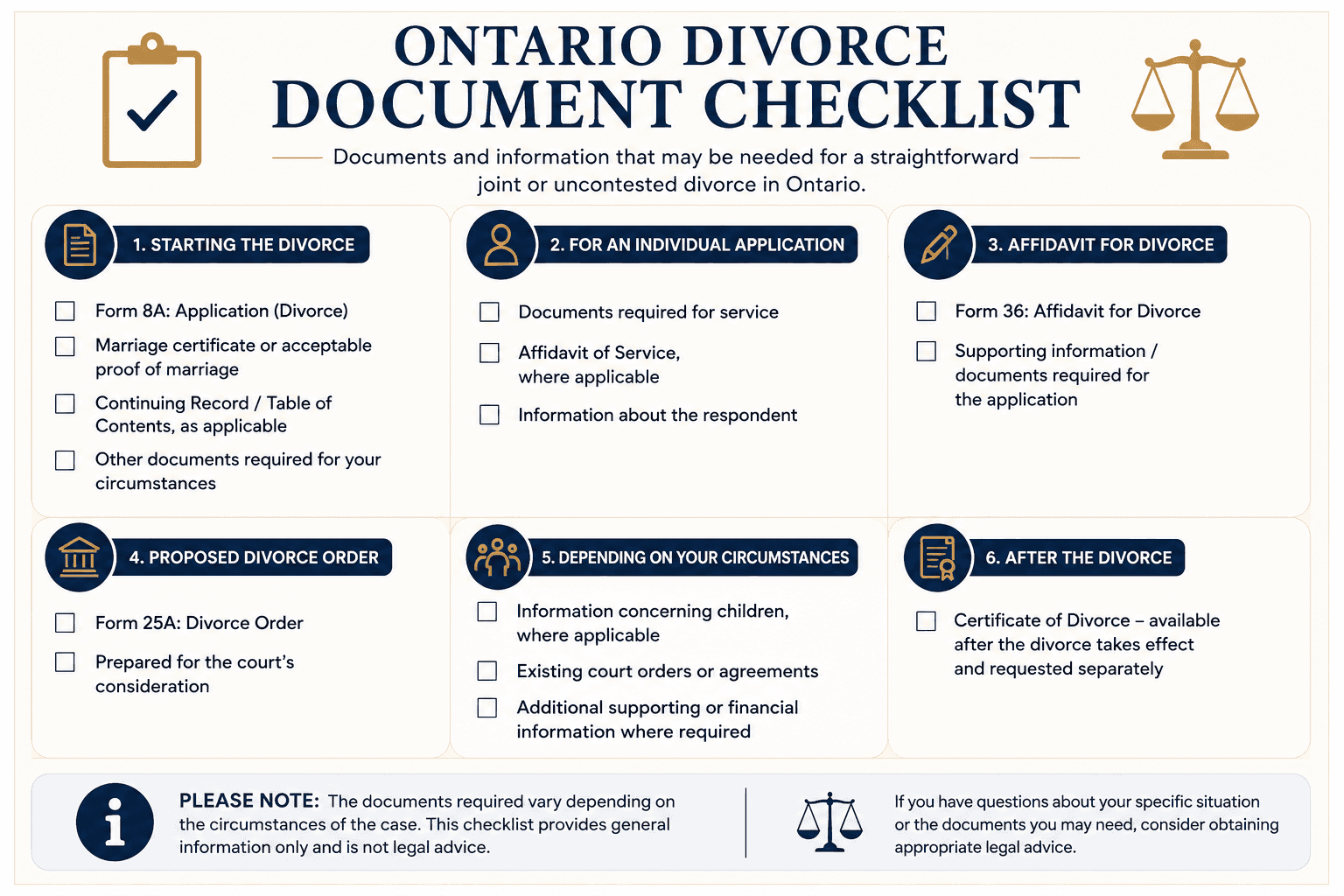
For a simple divorce-only application, one of the main court forms is Form 8A: Application (Divorce).
Form 8A is also used for a joint divorce application. The difference is in how the application is completed and who participates in it.
A simple divorce-only application generally requires:
Form 8A: Application (Divorce)
A Continuing Record, including a Table of Contents
Your original marriage certificate
Any other supporting documents that may be relevant to your circumstances
For a joint divorce, both spouses participate in the application and additional divorce documents are generally prepared as part of the filing process.
Generally, yes.
If you are asking an Ontario court for a divorce, your marriage certificate or marriage registration certificate must generally be filed with the court.
The court cannot grant the divorce until the required proof of marriage has been filed unless the court accepts an explanation as to why obtaining the certificate is impractical.
Your marriage certificate is therefore one of the first documents worth locating when you begin preparing for divorce.
Not having your marriage certificate does not necessarily mean you cannot get divorced.
If you were married in Ontario, you can order a marriage certificate from the Province of Ontario.
If you were married elsewhere in Canada, you may need to obtain the certificate from the province or territory where the marriage occurred.
If obtaining a marriage certificate is genuinely impractical, the circumstances may need to be explained to the court. The court will ultimately determine whether the available information is sufficient.
You can still apply for a divorce in Ontario if you meet the legal requirements for the Ontario court to deal with your divorce.
However, you will need appropriate evidence of your marriage.
If your marriage certificate was issued outside Canada and is not in English, Ontario's family-court guidance states that it must be translated by a certified translator.
International marriage documents can sometimes require additional attention, so it is helpful to deal with this issue early rather than discovering a problem after your application has been prepared.
Divorce forms require information about both spouses.
Depending on your circumstances, you should be prepared to provide information such as:
Full legal names
Current addresses
Date and place of marriage
Date of separation
Information about any previous court proceedings
Information about children of the marriage, where applicable
Details relevant to the basis on which the divorce is being requested
Having accurate information from the beginning can help reduce the likelihood that documents will need to be corrected later.
In a joint divorce, both spouses apply for the divorce together.
Ontario's current court guidance identifies documents for a joint application that include:
Form 8A: Application (Divorce)
Form 36: Affidavit for Divorce completed separately by each spouse
The marriage certificate or marriage registration certificate
Form 25A: Divorce Order
The Continuing Record and Table of Contents
Any additional supporting documents required by the circumstances
Because the spouses apply together, there is no respondent and the divorce application does not need to be served by one spouse on the other.
An individual uncontested divorce begins differently.
One spouse starts the application and is the applicant. The other spouse is the respondent.
For a divorce-only application, Form 8A is used to begin the proceeding.
Once the application has been issued by the court, it generally must be properly served on the respondent.
Someone other than the applicant who is at least 18 years old must generally serve the application using the required method of special service.
If the respondent does not file an Answer within the applicable time and the matter remains uncontested, the applicant may proceed with the additional documents required to ask the court to grant the divorce.
When an individual divorce application must be served, the court needs evidence that service was completed properly.
An Affidavit of Service records information about how and when the documents were served.
This is important because simply telling the court that your spouse received the papers is not enough.
The court needs the required proof of service before an undefended divorce can proceed through the remaining stages.
A joint divorce is different because there is no respondent to serve.
Form 36 is the Affidavit for Divorce.
It provides evidence the court uses when considering whether the legal requirements for granting the divorce have been satisfied.
Among other things, the form addresses the information contained in the divorce application, the legal basis for the divorce, information concerning children of the marriage where applicable, and other information the court may require.
For a joint application, each spouse completes a separate Form 36.
Form 25A is the proposed Divorce Order.
It sets out the order the parties are asking the court to make.
The fact that a draft Divorce Order is submitted does not mean the divorce has already been granted.
The documents must still be considered by the court, and a judge must be satisfied that the legal requirements for granting the divorce have been met. The judge may grant the requested divorce, require corrections or additional information, or deal with the proposed order differently where appropriate.
Having children does not automatically prevent you from obtaining a straightforward divorce.
However, children can affect the information and documentation required.
The court must consider the arrangements made for the support of children of the marriage before granting a divorce.
Depending on the claims being made and the circumstances of the case, additional documents or financial information may also be required.
If there are unresolved parenting, child-support or other family-law disputes, the matter may extend beyond a straightforward divorce-only application.
Not every divorce-only application requires the same financial documentation.
If the proceeding involves claims relating to child support, spousal support or property, financial disclosure requirements can become significantly more extensive.
Ontario court guidance identifies financial statements and other financial disclosure documents among the materials that may be required where support or property claims are being made.
This is one reason it is important to distinguish between obtaining the divorce itself and resolving the financial and family-law issues arising from a separation.
They are not necessarily the same process.
Divorce documents need to satisfy the court's legal and procedural requirements.
If information is missing, documents have been completed incorrectly or additional information is required, the application may not proceed as expected.
When divorce materials are presented to a judge, the judge can grant the requested divorce, require corrections, request additional evidence or, where the requirements have not been satisfied, decline to grant the requested order.
Correctly preparing the documents at the beginning can help avoid unnecessary delays.
No.
A Divorce Order is the court order granting the divorce.
A Certificate of Divorce is a separate document that can be requested after the divorce has taken effect. It provides official confirmation of the divorce and may be required later for purposes such as remarriage.
You do not receive a Certificate of Divorce simply because you filed your divorce application.
It comes at the end of the process, after the divorce has taken legal effect.
No.
You can prepare and file your own divorce documents, or you can obtain professional assistance if your matter falls within the professional's authorized scope of practice.
The important thing is to understand exactly what a service includes.
Some services may provide document preparation only, while others may include preparation, filing and assistance throughout the applicable court process.
When comparing divorce services, look beyond the advertised price and determine what work is actually being performed.

Do I Need My Marriage Certificate to Get Divorced in Ontario?
What If I Can't Find My Marriage Certificate?
Do Both Spouses Need to Sign Divorce Documents?
What Documents Are Needed After the Divorce Application Is Filed?
What Happens If My Divorce Documents Are Incomplete or Incorrect?

Cordaie Paralegal Services provides a flat-fee divorce service for eligible joint and uncontested divorces in Ontario.
For $995 + HST + disbursements, we handle the divorce process included in your retainer, including preparation and filing of the required divorce documents and communication concerning the court process.
Complete our short eligibility questionnaire to see whether your divorce may be a good fit for our service.
There's no obligation to retain us simply because you complete the eligibility check.

