Divorce Process
What Is an Uncontested Divorce in Ontario?
What Is an Uncontested Divorce in Ontario?
What Is an Uncontested Divorce in Ontario?
•
8 MIN READ
8 MIN READ

Divorce Process
•
Divorce does not always involve a courtroom battle between spouses. In many Ontario divorces, one spouse starts the divorce application and the other spouse does not oppose the divorce.
This is commonly referred to as an uncontested divorce.
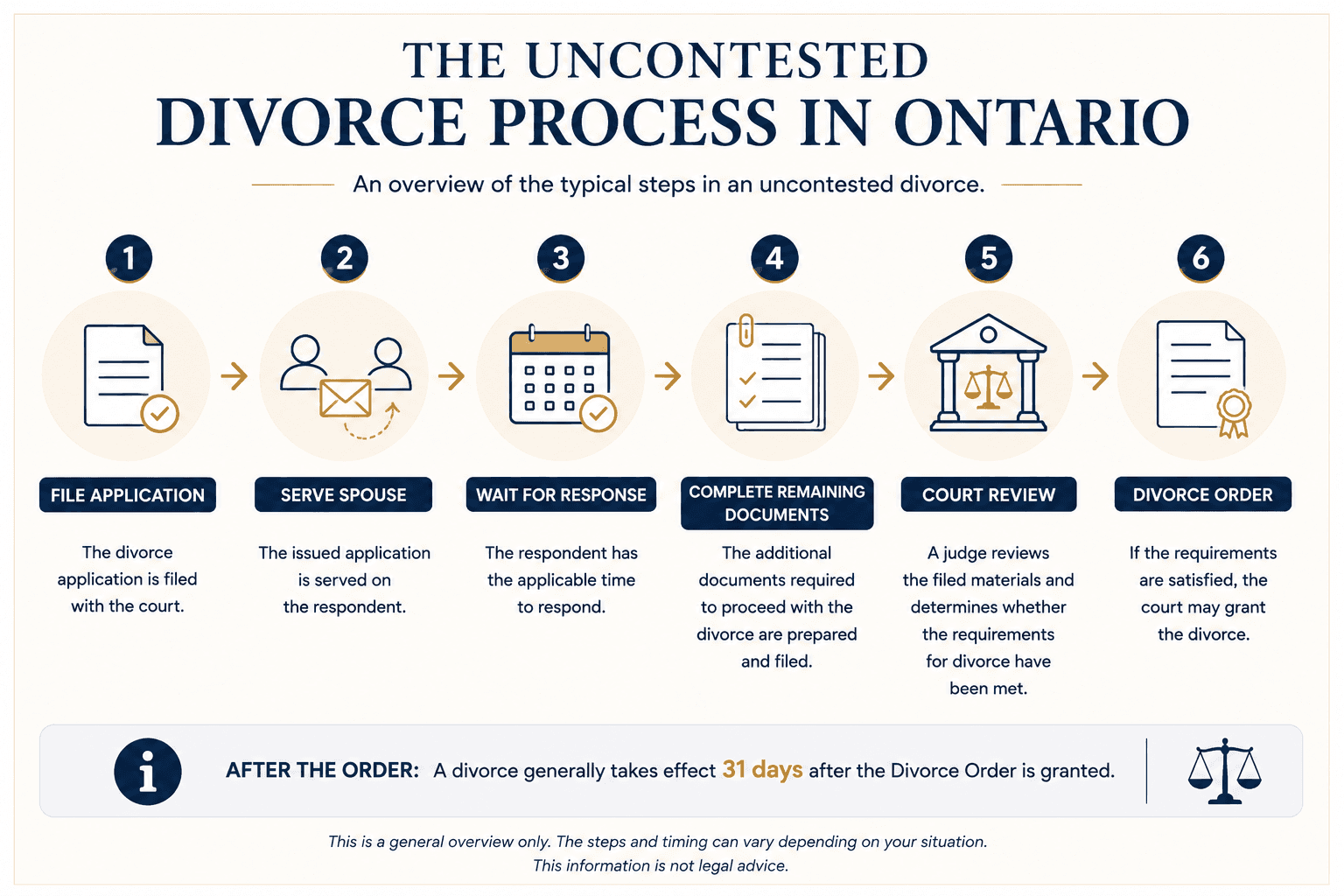
An uncontested divorce can be relatively straightforward, but it still involves a formal court process. The correct documents must be prepared and filed, the application generally must be served on the other spouse, applicable response periods must pass, and the court must be satisfied that the legal requirements for granting the divorce have been met.
It is also important to understand that an uncontested divorce and a joint divorce are not the same thing. Both can result in a straightforward divorce, but they begin differently and follow somewhat different procedures.
This guide explains what an uncontested divorce means in Ontario, who may qualify, how the process works and what happens if your spouse does—or does not—respond.
An uncontested divorce generally occurs when one spouse applies for a divorce and the other spouse does not oppose the divorce or defend the proceeding.
The spouse who starts the case is the applicant. The other spouse is the respondent.
The applicant files the divorce application with the court and, once it has been issued, the application generally must be properly served on the respondent.
The respondent then has an opportunity to respond.
If the respondent does not serve and file an Answer within the applicable time, the applicant may generally take the additional steps required to have the divorce considered on an uncontested basis.
An uncontested divorce is still a legal proceeding. A judge must ultimately be satisfied that the requirements for granting the divorce have been met.
Not necessarily.
The word uncontested describes what is happening with the court proceeding. It does not necessarily mean the spouses have a perfect relationship or agree about every issue arising from their separation.
However, unresolved issues involving matters such as parenting, child support, spousal support or property can make a divorce proceeding more complicated—particularly if one spouse asks the court to decide those issues.
For a straightforward divorce-only application, the spouses have often already resolved the other issues arising from their separation or those issues are not being litigated as part of the divorce proceeding.
If one spouse files an Answer disputing claims or making additional claims, the proceeding may no longer continue as a simple uncontested divorce.
Before an Ontario court can grant a divorce, the requirements under Canada's Divorce Act must be satisfied.
One important requirement concerns jurisdiction. Generally, either spouse must have been habitually resident in Ontario for at least one year immediately before the divorce proceeding is started.
There must also be a legally recognized ground for divorce.
The most commonly relied upon ground is that the spouses have lived separate and apart for at least one year.
A divorce proceeding based on separation can be started before the full year of separation has passed, but the divorce cannot be granted on that basis until the required one-year separation period has been completed.
There are also grounds based on adultery and physical or mental cruelty, although straightforward divorce applications commonly proceed based on one year of separation.
The biggest difference is who starts the application.
In an uncontested divorce, one spouse begins the proceeding as the applicant and the other spouse is the respondent.
In a joint divorce, both spouses apply for the divorce together.
Because both spouses are applicants in a joint divorce, one spouse generally does not need to serve the divorce application on the other. There is also no corresponding response period in the same way there is when one spouse brings an individual application.
An uncontested divorce, by contrast, generally begins with one spouse filing the application and then having the issued application properly served on the respondent.
Both approaches can ultimately lead to a straightforward divorce where there is no dispute requiring a contested hearing.
An uncontested divorce begins by preparing and filing the required divorce application and supporting materials with the appropriate Ontario court.
The documents need to contain the information required for the court to process the case, including information about the marriage, separation, spouses and any children of the marriage where applicable.
Once the application has been accepted and issued by the court, the next major step in an individual divorce proceeding is generally service on the respondent.
Filing the application alone does not complete the divorce.
In an individual divorce proceeding, the issued application generally must be served on the respondent by special service.
Importantly, the applicant cannot personally serve the divorce application on their spouse.
The applicant cannot personally serve the divorce application on their spouse. Service may be completed by another person who is at least 18 years old or by a professional process server, provided the applicable service requirements are followed.
After service has been completed, evidence of that service must be provided to the court in the required form.
Service is an important procedural requirement. If it is not completed properly, the divorce cannot simply proceed as though the respondent had been properly notified.
Once the respondent has been properly served, they have a limited period in which to serve and file an Answer.
Generally, a respondent served in Canada or the United States has 30 days.
A respondent served outside Canada and the United States generally has 60 days.
If the applicable response period expires and the respondent has not served and filed an Answer, the applicant may generally continue with the steps necessary to seek the divorce on an uncontested basis.
The divorce is not automatically granted simply because the response deadline has passed.
If the respondent does not serve and file an Answer within the applicable period, the applicant can generally proceed toward having the divorce dealt with as an uncontested matter.
Additional court documents still need to be prepared and submitted.
A judge will review the materials to determine whether the requirements for granting a divorce have been met.
Where there are children of the marriage, the court must also consider child support. Under the Divorce Act, the court has a duty to satisfy itself that reasonable arrangements have been made for the support of the children before granting the divorce.
So a spouse's failure to respond does not mean that the court simply issues a divorce automatically.
If the respondent serves and files an Answer, what happens next depends on what is being disputed or claimed.
A response does not necessarily mean that the spouses will end up in a lengthy court battle.
However, if the respondent opposes claims in the application or asks the court to determine other family-law issues, the matter may no longer be suitable to proceed through the straightforward uncontested-divorce process.
At that point, the procedural and legal issues can become considerably more complex.
A person facing a contested family-law proceeding should consider obtaining legal advice about their particular circumstances.
Yes.
Having children does not automatically prevent spouses from obtaining an uncontested divorce.
However, children add important considerations to the court's review.
Before granting a divorce, the court has a statutory duty to satisfy itself that reasonable arrangements have been made for the support of any children of the marriage, having regard to the applicable child support guidelines.
This is one reason information concerning children and child support may be required even when neither spouse is contesting the divorce.
If parenting, child support or other issues remain disputed and one of the spouses asks the court to determine them, the proceeding can become more complex.
The total cost depends on more than the professional fee charged to prepare and handle the divorce.
Potential costs can include:
Professional or legal-service fees;
Court filing fees;
Process-server costs where service is required;
Other applicable disbursements; and
HST on taxable professional services.
Cordaie Paralegal Services provides its eligible joint and uncontested divorce service for a flat professional fee of $995 + HST + disbursements.
Because government fees and other disbursements can change, they should be considered separately from the professional service fee.
There is no guaranteed completion time for an uncontested divorce in Ontario.
The overall timeline can depend on how quickly the documents are prepared, how long service takes, whether the respondent files an Answer, whether the court requires corrections or additional information and the court's own processing time.
After a judge grants the divorce, there is also another important period to account for.
Under the Divorce Act, the divorce generally takes effect on the 31st day after the day the judgment granting the divorce is rendered.
That means receiving a divorce order does not normally mean the marriage legally ends that same day.
For a straightforward uncontested divorce, the best approach is to complete each required step accurately and promptly while recognizing that court processing times cannot be guaranteed or controlled.

Do I Need My Spouse’s Agreement to Get an Uncontested Divorce?
What If My Spouse Refuses to Sign Divorce Papers?
Can I Get an Uncontested Divorce If I Don’t Know Where My Spouse Is?
Do We Have to Go to Court for an Uncontested Divorce?
Can an Uncontested Divorce Become Contested?

Cordaie Paralegal Services provides a flat-fee divorce service for eligible joint and uncontested divorces in Ontario.
For $995 + HST + disbursements, we handle the divorce process included in your retainer, including preparation and filing of the required divorce documents and communication concerning the court process.
Complete our short eligibility questionnaire to see whether your divorce may be a good fit for our service.
There’s no obligation to retain us simply because you complete the eligibility check.

